
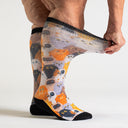
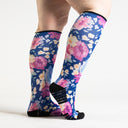


Compression socks can help with some types of lower-leg swelling by applying pressure that limits fluid buildup and supports blood flow back toward the heart. The right pair depends on why your legs are swelling, how much pressure you need, and whether the sock fits correctly. More compression is not automatically better.
For occasional tired or mildly puffy legs, a gentle over-the-counter pair may provide comfortable daytime support. Persistent, severe, painful, sudden, or one-sided swelling needs medical assessment before you choose a compression level. Swelling can have many causes, and a sock cannot diagnose or treat the underlying condition.
Start with the cause of the swelling
Swelling caused by fluid trapped in the tissues is called edema. It commonly appears in the feet, ankles, and legs. Prolonged sitting, pregnancy, certain medicines, and excess dietary salt can contribute to mild edema. Swelling can also be associated with chronic venous insufficiency, heart or kidney disease, liver disease, lymphatic problems, or a blood clot.
That range of causes is why it is important not to treat every swollen leg as a simple sock problem.
Make an appointment with a healthcare professional if swelling persists, recurs, produces stretched or shiny skin, or leaves a dimple when pressed. Seek urgent care for swelling with chest pain, shortness of breath, or an irregular heartbeat. Leg pain and swelling that do not resolve after prolonged sitting, especially when they affect only one side, also require prompt medical advice.
Once a clinician has ruled out urgent causes or advised that compression is appropriate, you can focus on pressure, length, size, and fit.
How compression socks help with swelling
Graduated compression socks apply the greatest pressure at the ankle and gradually ease higher on the leg. That pressure pattern can reduce the diameter of the veins, support upward blood flow, and limit fluid from collecting in the lower tissues.
This is different from simply wearing a tight sock. A properly made compression garment provides a specified pressure level and a planned pressure gradient. A sock that is too small, bunched, folded, or rolled can create concentrated pressure in the wrong place.
Compression can help manage symptoms related to some venous and lymphatic conditions, but it does not cure the underlying cause of edema. The results also depend on wearing the right garment consistently and safely.
Choose the pressure level before choosing the pattern
Compression strength is commonly expressed in millimeters of mercury, abbreviated as mmHg. A range such as 12–15 mmHg describes the amount of pressure the sock is designed to apply.
The labels used by manufacturers and health systems are not perfectly standardized worldwide. The table below reflects common consumer ranges described by Cleveland Clinic, while clinical classifications can vary.
|
Compression level |
Common description |
General context |
|
8–15 mmHg |
Mild |
Gentle everyday support for tired legs or minor puffiness |
|
15–20 mmHg |
Moderate |
More noticeable support; often used for travel or mild swelling |
|
20–30 mmHg |
Firm |
Frequently used for medical needs under professional guidance |
|
30–40 mmHg |
Extra firm |
Medical-grade compression that should be used with clinical supervision |
These ranges are a starting point, not a self-diagnosis tool. If you are buying compression to address a medical concern, Cleveland Clinic advises getting measured and asking a healthcare professional to recommend the pressure level.
If a clinician prescribes a particular strength, do not replace it with a lighter or stronger pair without asking. Sizing down is also not a safe way to create “more compression.” Pressure should come from the garment’s design, not from forcing your leg into the wrong size.
Select a length that covers the area you need to support
Knee-high compression socks are widely used for lower-leg swelling. Mayo Clinic notes that stockings ending just below the knee can help limit lower-leg swelling caused by fluid buildup.
Thigh-high stockings, tights, or other garments may be recommended when symptoms extend above the knee or when a medical condition requires broader coverage. The appropriate length should follow the location of the swelling and any guidance from your healthcare professional.
The garment should end smoothly. Do not fold the top down to shorten it, because doubled fabric can create a band of excessive pressure.
Measure when your legs are least swollen
Correct measurements help the sock deliver its intended pressure. Check the manufacturer’s size chart rather than relying only on shoe size. Knee-high sizing often uses ankle circumference, calf circumference, and lower-leg length.
Measure early in the morning, when your legs are typically least swollen. Mayo Clinic recommends professional fitting for prescribed stockings and notes that severe swelling may need to be reduced before accurate fitting is possible.
If your measurements fall between sizes or your leg shape does not match a standard chart, ask a pharmacist, medical-supply specialist, or healthcare professional for help. Poorly fitted graduated compression stockings can cause discomfort and, in serious cases, skin injury.
A good fit feels snug, smooth, and even
Compression socks should feel more supportive than ordinary socks, especially around the ankle. They should not feel painful or create isolated pressure points.
After putting on a pair, check that:
• The heel sits in the correct position.
• The fabric lies smooth without wrinkles or bunching.
• The top stays flat rather than rolling into a narrow band.
• Your toes retain their normal color and temperature.
• You do not develop pain, numbness, tingling, or worsening swelling.
Do not pull only at the top band. Work the fabric gradually over the heel and up the leg, then smooth it from the ankle upward. The Viasox guide How to Put On a Compression Sock provides a step-by-step technique.
If your pair feels uncomfortably restrictive, review Are Your Compression Socks Too Tight? before assuming that discomfort means the socks are working.
Put them on before swelling builds
Compression socks are usually easiest to apply early in the morning, before the feet and ankles have become more swollen. Make sure your skin is dry and any lotion has absorbed before you begin.
For general daytime use, put the socks on in the morning and remove them before bed. Do not sleep in compression socks unless a healthcare professional has specifically instructed you to do so.
Check your skin when you remove the socks. New redness, irritation, blisters, or changes in skin color may indicate a fit problem. Persistent swelling despite compression also deserves professional advice.
Know when compression needs medical guidance
Compression garments are safe for many people, but they are not appropriate for every leg or every cause of swelling.
Ask a healthcare professional before using compression socks if you have severe or unexplained swelling, peripheral artery disease, severely reduced sensation, open wounds, a skin infection, or extremely fragile skin. Peer-reviewed clinical guidance also identifies impaired arterial flow, severe peripheral neuropathy, massive leg edema, and certain skin conditions as reasons for careful assessment before graduated compression is used.
Remove the socks and seek advice if you develop pain, numbness, tingling, skin discoloration, skin damage, or worsening swelling. These symptoms may mean the pressure, size, or garment is not appropriate. They may also point to a medical issue that needs evaluation.
Compression socks and non-binding socks serve different purposes
A non-binding sock uses a flexible cuff to avoid concentrated pressure. It may feel more comfortable when a conventional sock top digs into the leg, but it does not provide graduated compression.
A compression sock deliberately applies pressure from the ankle upward. If your healthcare professional recommends compression for swelling, a non-binding sock is not an equivalent substitute. If the priority is relaxed everyday comfort rather than prescribed pressure, read What Non-Binding Socks Are and How Do They Work?.
Where Viasox fits in the compression range
Viasox full-length compression socks provide 12–15 mmHg of gentle graduated compression. The current collection page describes them as snug at the ankle and less firm higher on the leg. It lists a maximum calf fit of 18 inches and recommends daytime wear.
That places Viasox in the mild, everyday-support range rather than the firm medical-compression range. They may be an option when gentle compression is appropriate for your needs. They should not replace a prescribed 20–30 mmHg or 30–40 mmHg garment.
Before ordering, compare your measurements with the current size chart. If you need help deciding whether 12–15 mmHg is suitable for your swelling, ask a qualified healthcare professional.
For a broader overview of pressure levels, uses, and shopping considerations, see The Complete Guide to Compression Socks in 2026.
If gentle 12–15 mmHg support is appropriate for you, explore Viasox compression socks in classic colors and patterned designs.
Medical information disclaimer: This article provides general educational information and is not medical advice. Compression socks do not diagnose or cure edema, blood clots, venous disease, heart disease, kidney disease, diabetes, or other medical conditions. Seek professional guidance for unexplained, persistent, severe, painful, or one-sided swelling and before using compression for a medical concern.